ControlMap

CMMC for MSPs

CMMC 2.0 is here.
Own the shift
with ControlMap.

CMMC 2.0 requirements create new expectations for DoD/DoW contractors and the MSPs who support them.

Start, scale, and conquer compliance with ControlMap by turning complex frameworks into repeatable workflows so your team can support CMMC confidently across every client.

  • Manage CMMC readinessRun NIST 800-171A assessments and track readiness from one workspace.
  • Build audit-ready deliverablesSupport SPRS reporting, SSPs, Shared Responsibility Matrix (SRM), CUI evidence, and more.
  • Standardize across clientsUse repeatable frameworks and workflows instead of manual mapping or third-party templates.

The compliance platform built for MSP service delivery

63+
Frameworks supported
40+
Native integrations
50+
Audit-ready templates

Why CMMC matters now

Help clients keep contract eligibility while building a repeatable service motion

CMMC 2.0 creates one of the largest compliance service opportunities MSPs have seen. Organizations handling Controlled Unclassified Information need to meet NIST 800-171 and CMMC Level 2 requirements to remain eligible for DoD (now DoW: Department of War) contracts, while Level 1 focuses on protecting Federal Contract Information.

CMMC readiness center of excellence logo

A major compliance service opportunity

An estimated 300k to 500k businesses are impacted globally.

Contract-driven urgency

Defense contractors and subcontractors must demonstrate cybersecurity maturity under CMMC 2.0.

A clear MSP advisory role

Clients need help scoping CUI, prioritizing gaps, collecting evidence, and staying ready over time.

Manage CMMC requirements in ControlMap

Turn CMMC complexity into repeatable MSP workflows

ControlMap helps you manage readiness, run assessments, and deliver audit-ready evidence aligned with NIST 800-171.

Frameworks

CMMC frameworks and assessments without manual mapping

ControlMap includes CMMC Level 1 and Level 2 frameworks mapped to NIST 800-171r2 and 800-171A so your team can launch readiness assessments quickly.
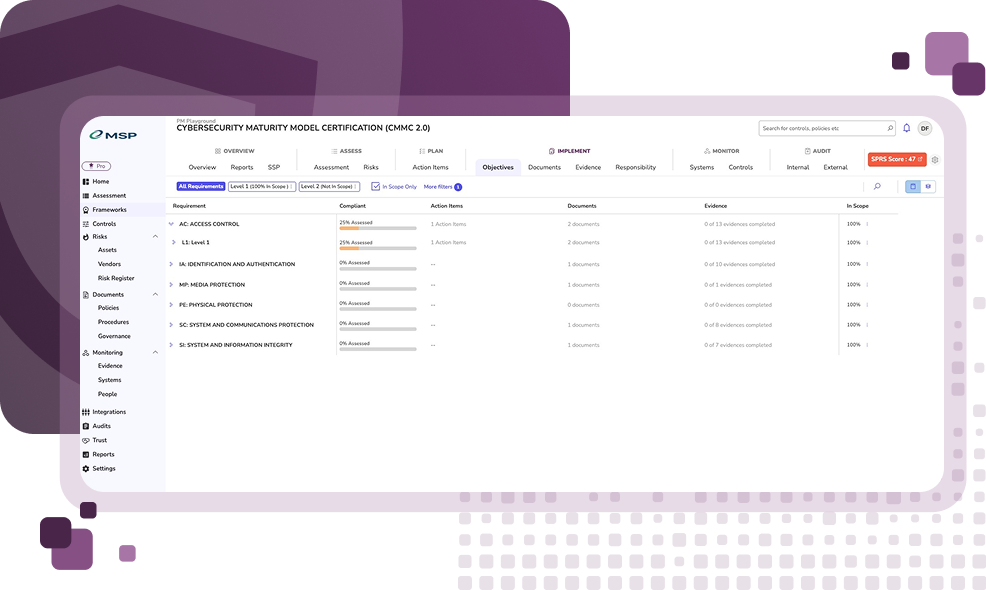
CMMC-native workflows in ControlMap
SPRS + SSP

Manage POA&Ms, SPRS scoring, and SSPs in one motion

Generate the evidence and planning artifacts clients need as they move from gap analysis to remediation and readiness review.

ControlMap system security plan builder
Evidence

Link CUI labels, controls, and evidence for audit readiness

Keep CMMC evidence organized by control and tagged for CUI, with traceability for assessor conversations and export-ready packages.
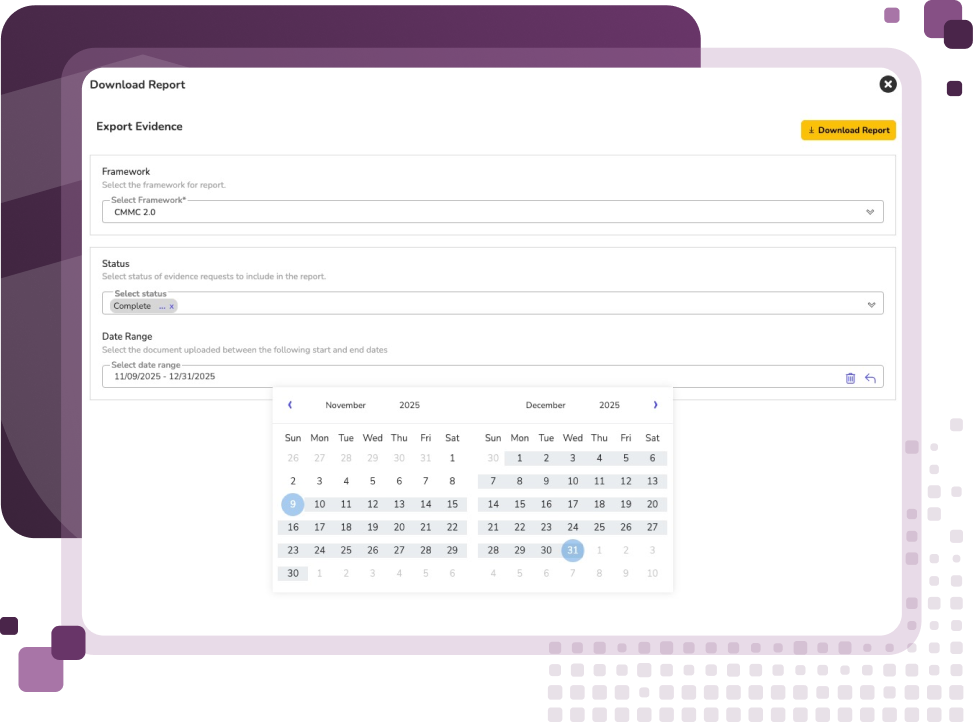
Audit-ready CMMC evidence in ControlMap

Why MSPs choose ControlMap for CMMC

ControlMap gives MSPs a purpose-built way to standardize CMMC delivery, prove readiness, and clarify responsibility across regulated client environments.
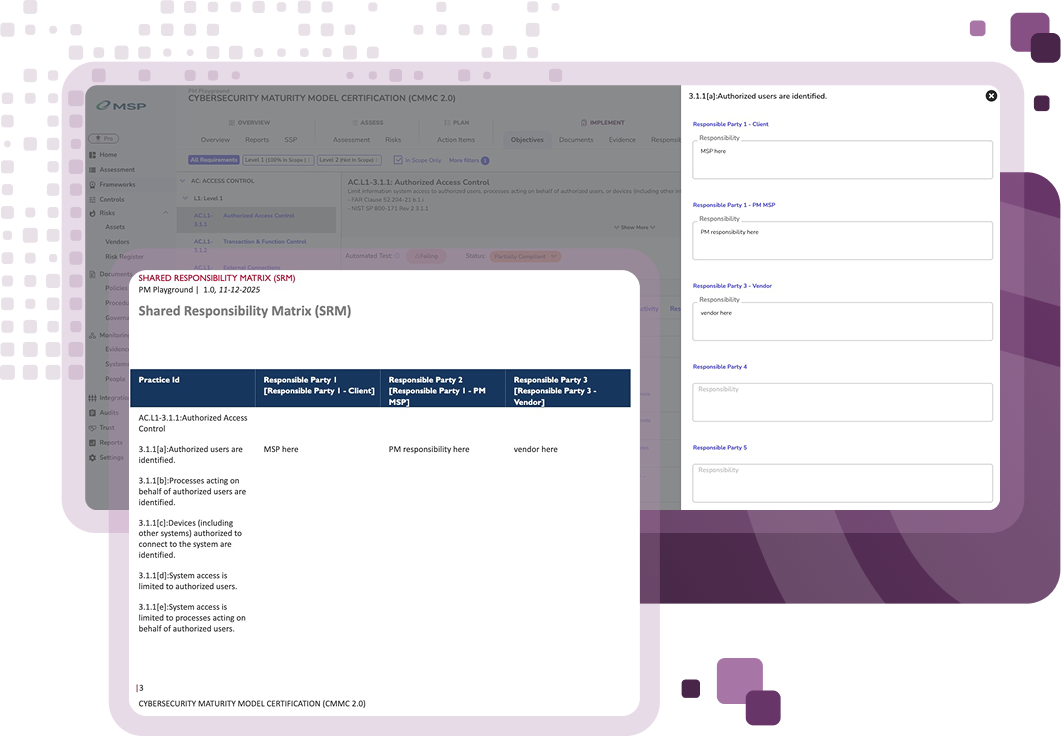
Shared accountability workflows in ControlMap

Purpose-built for MSPs

ControlMap enables MSPs to manage every client environment from a single workspace. Tenant cloning makes it easy to replicate proven CMMC setups across similar clients. This saves hours of manual work and helps ensure consistent delivery.

American flag representing CMMC defense contractor requirements

Trusted results

ControlMap aligns directly with DoD/DoW expectations and assessor requirements. Hundreds of MSPs supporting thousands of clients trust ControlMap to prepare for certification because of its consistent track record of success.

CMMC-native workflows in ControlMap

CMMC-native workflows

ControlMap includes CMMC Level 1 and Level 2 frameworks mapped to NIST 800-171r2 and 800-171A. You can launch readiness assessments and manage every requirement without manual mapping or third-party templates.

Audit-ready CMMC evidence in ControlMap

Audit-ready evidence

Evidence in ControlMap is automatically organized by control and tagged for CUI, giving auditors full traceability. Reports export in DIBCAC and eMASS formats, helping compliance packages meet federal and assessor standards.

FedRAMP Moderate equivalency badge

FedRAMP Moderate Equivalency

ScalePad is audited annually for SOC 2 and ISO 27001. ControlMap has mapped these controls to a FedRAMP Moderate equivalency assessment, validating adherence to stringent federal security controls.

Shared responsibility matrix workflow in ControlMap

Shared accountability

Define what is owned by your team and what is owned by the client with a built-in Shared Responsibility Matrix (SRM). Clients can access the same workspace, so both sides stay aligned on responsibilities and progress throughout the compliance process.

What compliance leaders are saying

Evidence management has been the biggest X-factor. Being able to drop everything into one central location—instead of dealing with back-and-forth file sharing—makes the whole process much more manageable. It’s hard to imagine going back to how we were doing it before. It’s really improved productivity.

Jacob Fitzgerald

Management Specialist, Automated Evidence & Audit Readiness

ControlMap provides an easy-to-use platform which allowed our GRC team to completely revamp the way we approach policy, governance, vendors, and risk management in a single platform. Previously, we were utilizing a handful of disparate solutions to provide these functions within our GRC program. Now our Risk Management Program is housed in a single platform, allowing for easier administration, navigation, and linking of information between policy, control mapping, evidence gathering, and risk treatment.

Kent G

Chief Information Security Officer

I use ScalePad ControlMap for Governance Risk and Compliance for strict frameworks like CMMC and NIST. It provides one management platform for myself and my team, enhancing communication between MSPs and clients.

Robert Duchesne

vCISO, Chief Executive Officer

Next step

HELP CLIENTS GET CMMC-READY AND GROW YOUR COMPLIANCE BUSINESS.

ControlMap gives MSPs a repeatable way to guide clients through CMMC readiness, evidence collection, assessment workflows, and ongoing compliance operations.

Use ControlMap to:

  • Assess readiness against CMMC and NIST 800-171 requirements.
  • Organize evidence by control, owner, client environment, and CUI context.
  • Scale delivery with repeatable workflows across regulated clients.

CMMC FAQ

Common CMMC questions for MSPs

  • When is an MSP considered “in scope” for CMMC 2.0, and do they need the same level as the client?
    An MSP becomes in scope when its people, processes, or systems can access, store, process, or transmit a customer’s CUI or directly impact the security of CUI systems, such as admin access into an enclave or customer tenant. The MSP does not automatically need the same certification level as the client, but the more direct access and control an MSP has, the stronger the expectation that the MSP meets equivalent requirements.
  • What certification or registration requirements apply to MSPs, MSSPs, RPOs, and consultants?
    CMMC certifies organizations that handle CUI, not tools or individuals. RPOs and C3PAOs must be listed in the Cyber AB marketplace. MSPs and MSSPs supporting Level 2 environments should be prepared to show how their own practices align to NIST 800-171, even if they are not formally certified yet.
  • How should MSPs scope their own tools and infrastructure for CMMC 2.0?
    Anything that can touch or administer CUI systems may come into scope, including RMM tools, PSA, ticketing, SIEM, and backup solutions. Common strategies include separate tenants or tool instances for CMMC customers, restricting technician access, using just-in-time privileged access, and avoiding agents inside the enclave when they are not needed. A clear Shared Responsibility Matrix (SRM) is essential to document what the MSP does and does not do.
  • When should organizations use a CMMC enclave, and how do you choose cloud vs. on-prem?
    An enclave is appropriate when only part of the environment needs to handle CUI, or when you want to sharply limit CMMC scope. Cloud-based enclaves such as GCC, GCC High, or compliant IaaS are often faster to deploy and easier to standardize. On-prem enclaves may be preferred for manufacturing equipment, legacy systems, or special connectivity needs.
  • When is Microsoft 365 GCC or GCC High required, and can customers stay in commercial tenants?
    CMMC 2.0 is based on NIST 800-171, which is technology-agnostic. Microsoft 365 Commercial can meet CMMC requirements if it is properly configured, the organization can demonstrate compliance with applicable controls, and contracts permit it. GCC or GCC High may be needed when contract, ITAR, export-control, or data residency requirements demand it. ControlMap follows a similar approach: ControlMap Commercial USA regions are hosted on AWS East/West for most common use cases, while AWS GovCloud is FedRAMP High and may be necessary for ITAR or specific compliance requirements.
  • What expectations apply to third-party tools (RMM, backup, XDR, etc.) in CMMC environments?
    Third-party providers that can access CUI or security-relevant data must support appropriate controls such as strong authentication, secure development practices, logging, and data residency consistent with contract requirements. FedRAMP Moderate or High is not always mandatory, but it is a strong maturity signal for SaaS used with CUI.
  • How can MSPs design backup and disaster recovery for CUI without bringing their entire footprint into scope?
    Segment backup infrastructure for CUI workloads. Use dedicated backup repositories or tenants for CMMC customers, and ensure encryption, access control, and logging meet NIST 800-171 expectations. Avoid sending CUI backups into shared MSP platforms where other clients’ data resides or where many technicians have broad access.
  • What are the practical steps from self-assessment to C3PAO audit, and what should be budgeted?
    Organizations typically start with scoping, gap analysis, and a NIST 800-171 self-assessment to generate an SPRS score. Next comes remediation: policies, technical controls, documentation, and evidence collection. Many then use an RPO or consultant for a readiness review before scheduling a C3PAO assessment. Budget for remediation and ongoing control maintenance, not just the formal audit. C3PAO assessors such as Kyle Lai from KLC Consulting suggest planning up to 12 months for CMMC implementation.
  • How do you identify and scope CUI, including derived data and physical artifacts?
    Start from contracts, flow-down clauses, and government or prime guidance to identify what is explicitly marked as CUI. Then analyze where that information flows, including CAD files, g-code, modified drawings, ERP systems, email, and physical printouts. Derived data can still be CUI if it reveals or is generated from CUI content. Document the scoping rationale so assessors can see how decisions were made.
  • How do CMMC 2.0 audits differ from SOC 2 or ISO 27001?
    SOC 2 and ISO 27001 are broader, risk-based frameworks that are often tailored to an organization’s chosen scope and controls. CMMC 2.0 Level 2 is tightly mapped to NIST 800-171, with a defined set of practices and assessment objectives that must be met. There is less flexibility to compensate with different controls.
  • What ongoing activities are required after achieving “110 of 110” to stay compliant?
    CMMC 2.0 is a continuous practice, not a one-time project. Organizations must maintain policies, review logs, manage vulnerabilities, test incident response, update system security plans, track changes, and reassess risks regularly. Recurring cyber hygiene tasks and documented evidence are critical so the organization can show it is still operating at the assessed maturity level.
  • How can MSPs support both CMMC and non-CMMC clients without over-complicating operations?
    Define clear service tiers and reference architectures. For CMMC customers, use hardened baselines such as secure configurations, stricter MFA, logging, and separated tenants where feasible. For non-CMMC clients, apply a subset of the same controls with more flexibility. Align internal processes so technicians follow consistent playbooks with specific extra steps for regulated environments.
  • What are effective discovery questions and sales approaches for cost-sensitive SMBs?
    Anchor conversations in mission outcomes: contracts at risk, supply-chain expectations, and potential revenue loss if clients cannot meet CMMC requirements. Ask which contracts mention DFARS, CMMC, or NIST 800-171, what data they exchange with prime contractors, and what audits they have faced. Frame recommendations as a prioritized roadmap, not an all-or-nothing purchase.
  • How can a GRC platform help an MSP manage CMMC 2.0 evidence, scoping, and audits for clients?
    A GRC platform centralizes requirements, controls, assets, and evidence so each CMMC practice can be traced to policies, systems, owners, and proof. It helps manage scoping decisions, POA&Ms, a Shared Responsibility Matrix (SRM), and a living System Security Plan. For audits, organized evidence makes it easier to answer assessor questions without hunting through file shares and email threads.
  • If a client only handles FCI, are they required to be Level 2 certified?
    No. If a client only handles Federal Contract Information, they generally fall under CMMC Level 1 and complete an annual self-assessment aligned to FAR 52.204-21. Contract clauses should still be reviewed to confirm whether CUI is in scope, because CUI would drive Level 2 requirements.