


Chapter 2
Business Operations
Workforce Shifts and Executive-Employee Misalignment Create Operational Pressure Points
The best-run MSPs track more metrics, plan smarter, and invest deliberately in their teams. But beneath the surface, misalignment around operational metrics, AI use, and team capacity may cause even strong operators to leave revenue on the table.
Leading MSPs Prioritize Tracking Service Speed and Team Productivity Metrics
They say “what’s measured is managed,” and top MSPs prove it: those who track more operational analytics tend to out-earn their peers and have higher CSAT scores. They’re more likely to track a wide variety of metrics — especially Average Resolution Time, Technician Productivity, and Average First Response Time — which shows that keeping an eye on service speed and team efficiency pays off.
MSPs that want to better understand the connection between client service and employee productivity may want to find ways to track some related — but less popular and harder to standardize — metrics, like Employee Turnover, Escalation Rate, and Aggregate Service Desk Productivity (which only about a third of respondents currently track).

Operational Business Metrics Tracked
Selling and Onboarding Are the Channel’s Most Persistent Pain Points
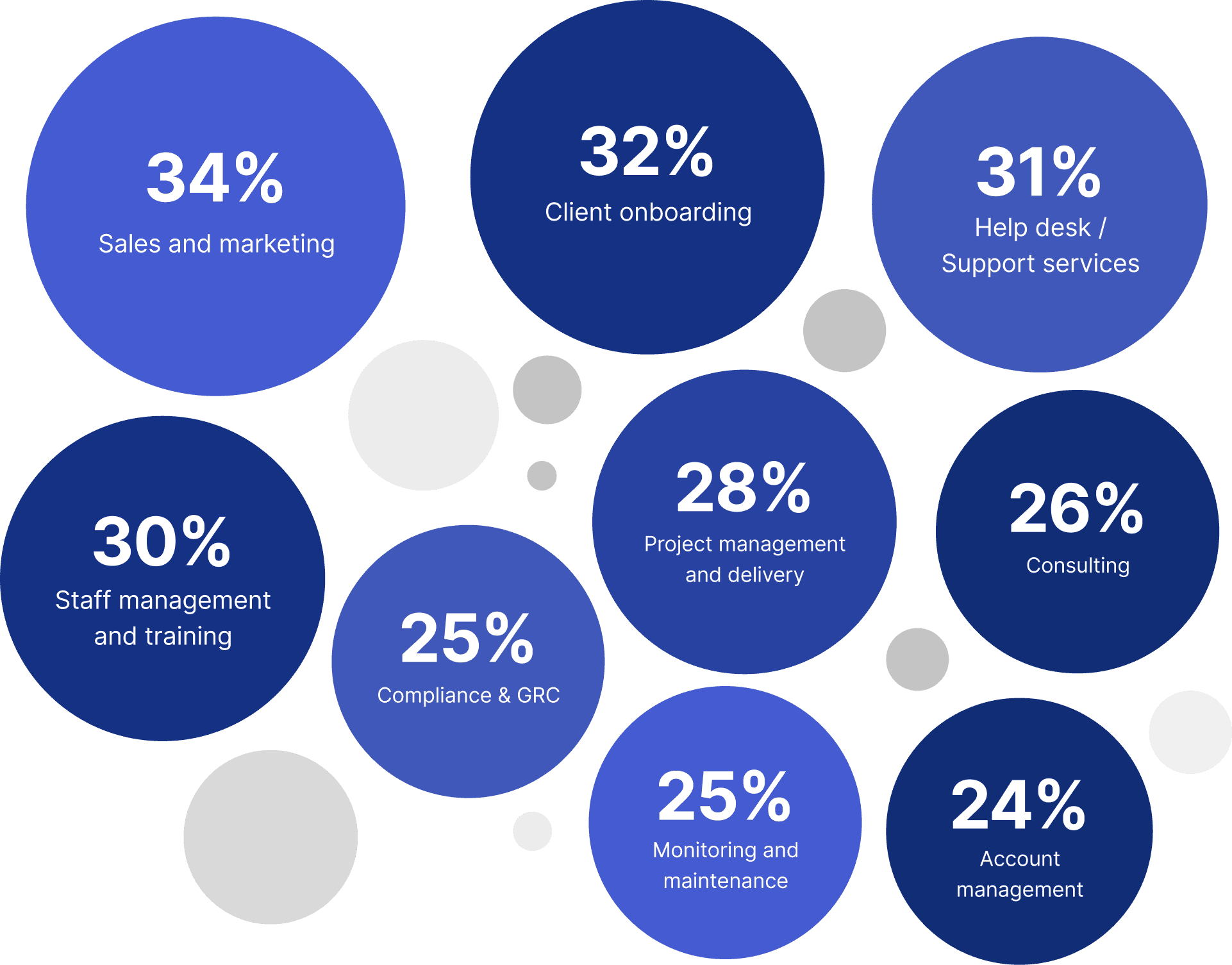
There’s only a 10% difference between responses on the least efficient areas of MSPs’ businesses, meaning challenges are varied across providers, and no single function is a universal bottleneck.
The biggest inefficiency areas show up early in the client relationship: “Sales and marketing” and “Client onboarding.” Since MSPs with stronger customer success programs (like formal onboarding, account management, and vCIO services) tend to perform better, standardizing client engagement processes and taking a more consultative sales approach should help MSPs overcome these issues.
Least Efficient Business Areas
The key to unlocking the door to future expansion is a positive onboarding and adoption experience. You never get a second chance to make a first impression. If clients don’t feel you are programmatic, methodical, and systematic in the way you onboard them into your environment over the first 90 days, they won’t be confident enough to bet future business on a long-term relationship with you. All expansion and retention is predicated on a successful adoption and onboarding experience.


The key to unlocking the door to future expansion is a positive onboarding and adoption experience. You never get a second chance to make a first impression. If clients don’t feel you are programmatic, methodical, and systematic in the way you onboard them into your environment over the first 90 days, they won’t be confident enough to bet future business on a long-term relationship with you. All expansion and retention is predicated on a successful adoption and onboarding experience.
Ryan Morris
Chief GTM Analyst
Morris Management Partners
MSPs Must Find “Goldilocks Zone” for Technical Staff Utilization
Self-reported utilization varies widely across MSPs, and lower reported rates may indicate differences in definition and tracking rather than true capacity levels. Higher technical staff utilization rates are often linked to better financial performance, higher ARPU, stronger CSAT scores, and an increased likelihood of hiring in 2026.
But MSPs with the highest utilization rates are also more likely to report higher client churn. Those struggling with retention tend to see account management, monitoring and maintenance, and project delivery as inefficient. This suggests that consistently high staff utilization makes it hard for teams to keep up with these tasks — potentially leading to poorer client service and higher attrition.
The takeaway? Increasing utilization rates can drive performance, but only up to a point. Since nearly half of high performers tend to fall in the 51%-75% utilization range, this is likely the sweet spot for balancing productivity and client service. MSPs in the 75%+ range should consider adjusting workloads, processes, or staffing to avoid potential capacity constraints.
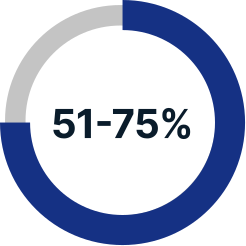
The most common utilization rates for high performers.
Utilization Rate for Technical Staff

High utilization can lead to high client churn because if you’re burning through people, you’re likely burning through clients. The industry average is around 80% — but that doesn’t give technicians a lot of breathing room, and they’re mostly firefighting at that point. I try not to go above 60-65% staff utilization so there’s enough time for training, certifications, and growing their skills.
Matthew Bookspan
Founder & President
Blacktip
Nearly a Third of MSPs Have Bullish Hiring Plans for 2026
Nearly half of MSPs plan to slow or freeze hiring, or outsource labor this year, while another quarter plan to hold steady at their current team size, likely due to economic uncertainty. Those who are hiring less tend to have lower CSAT scores and say rising salary expectations are a key issue, suggesting a relationship between service performance, client growth, and hiring budgets.
However, nearly a third of MSPs plan to increase headcount in the year ahead, despite looming economic uncertainty. Top performers and those who track more metrics are more likely to increase hiring — showing that strong financial performance and visibility into key business metrics give MSPs the confidence to invest in new roles during a potential downturn.
Most Common Roles Being Hired in 2026
 Sales people
 Security specialists
 General technicians
Hiring Approach for 2026
In-House Roles to Hire in 2026
MSPs Challenged by Hiring — But Employee Retention May Sour Customer Experience
MSPs are more concerned about “Finding skilled technical staff” (31%) than “Retaining current employees” (11%). But employee retention isn’t just about saving on recruiting costs or shortening ramp time — it can also impact the client experience: MSPs with lower client churn and higher CSAT scores are more likely to invest in more retention efforts, like career growth planning and ongoing education — suggesting a link between employee retention and customer retention.
A fifth of MSPs say “Training and upskilling” is their biggest talent obstacle. Since finding new technical hires is a top challenge, prioritizing internal people development may be a less expensive way to help bridge the talent gap.

Employee Retention Practices
Top Hiring and Employee Development Challenges

You need to take a sober assessment of the skills and talent you have in-house: what kind of markets you’re skilled in, what you want to go after, and if you have the people to support that. You may discover you can easily groom an internal resource using vCISO acceleration programs. If you bring in outside help from the enterprise or consulting world, make sure to give them the blueprint to operate in an MSP context.
Jesse Miller
Founder & Creator of the PowerGRYD vCISO System
PowerPSA Consulting
The Executive vs. Employee Expectations Gap
One of the operational challenges many MSPs face is misaligned perspectives between executives and customer-facing employees. Here’s how to close the gaps and improve performance.
| Topic | Mindset | How to Align |
|---|---|---|
| Team Turnover | Customer-facing teams are more likely to say retention is their big talent challenge. Leaders are less worried and perhaps see turnover rates as acceptable without considering employee concerns about replacements. |
|
| Employee Retention | Leaders report offering more retention programs than employees say they actually receive — meaning employees may not be fully aware of what’s offered or take advantage of these programs. |
|
| Level of Work Enjoyment | Client-facing teams are more likely to say they feel “neutral” or “enjoy their work most of the time.” Executives are more likely to “really enjoy their work” — a gap worth closing, given how front-line staff impact the client experience. |
|
| AI Adoption | Employees are more likely to say they use AI less than executives say it's being used. They’re also more likely to see their AI use as “somewhat effective,” while leaders feel it’s “very effective.” Executives also see AI as a business opportunity, whereas staff see it as "somewhat more opportunity than risk.” |
|
| Client Satisfaction and Churn | Employees say their CSAT scores are “Average” and report they lost a larger proportion of clients over the past year, while executives were more likely to say CSAT is “Excellent” and that they lost almost no clients — meaning one group may not have the right level of insight into customer sentiment and renewals. |
|
| Client C-Suite Engagement | Leaders are more likely to say executives from their clients’ teams are regularly involved in business reviews. In contrast, employees are more likely to say executives “rarely” or only “occasionally” are present. |
|
| Customer Success | Executives have a rosier view of their customer success processes than employees: leaders are more likely to report having more success practices in place (like account management and technology roadmaps) and tracking more related metrics (like NPS and security reports) than their employees. |
|
| Hiring Trajectory | Employees are more likely to think hiring will freeze or slow down in the year ahead, while executives are more likely to say they plan to increase recruiting. |
|
| Business Metrics | Employees are less likely than leaders to know their ARPU, percentage of recurring revenue, or projected growth rates. |
|
| Growth Outlook | Frontline employees think growth in the year ahead will come from acquisitions or partnerships with other MSPs, while leaders predict it will come from a combination of cold outreach and growing customer accounts. |
|
What Top Performers Do Differently
Investing in People to Fuel Growth
High-earning MSPs know that, even with the advent of AI, investing in people is still vital to business growth. While some MSPs are on a hiring freeze in the year ahead, top MSPs are planning to actively recruit — especially for helpdesk or security roles.
Top-performing MSPs also invest far more in keeping their people by offering clear career paths, competitive pay and bonuses, flexible work, ongoing training, and real team-building. Fittingly, their teams are much more likely to genuinely enjoy working there.
Top performers also track more team productivity metrics, which helps them increase utilization rates and better forecast hiring needs.