


Chapter 4
Customer Success + Services
Customer Success Maturity and Compliance Offerings Give MSPs a Competitive Edge
MSPs that embed more Customer Success practices and compliance-related services into their operations outperform their peers. But client churn, service delivery, and QBR preparation can still prove challenging — even among some top performers.
Better CSAT Scores Linked to Higher Revenue — Unless Price and Complexity Get in the Way
MSPs with the highest CSAT scores are more likely to be top revenue earners, with higher recurring revenue, ARPU ($300+), and projected growth rates. What’s driving their high CSAT scores? A combination of strong QBRs, effective AI adoption, and the ability to show clients value. MSPs with above-average CSAT are also more likely to see compliance as “Extremely important” — suggesting a focus on compliance advisement may help boost customer satisfaction.
When asked what’s preventing them from earning higher CSAT, MSPs cited client price sensitivity, increasingly complex technical requests, and inconsistent communication or slow response times — signaling that when complex, higher-value services aren’t delivered and communicated about in a timely or transparent way, customers will become dissatisfied with the costs.
CSAT Scores
CSAT Score Improvement Challenges
Strategic Customer Success Can Reduce Churn — But CSAT Alone Can’t Predict Retention
MSPs with lower churn are more likely to invest in formal Customer Success motions, including account management, strategic support or vCIO services, and structured onboarding. They’re also more likely to provide longer-term roadmaps (1–2+ years), run effective monthly or quarterly QBRs, share more data with clients, and confidently showcase business value to clients. On the other hand, MSPs with higher churn rates are more likely to have lower CSAT scores and cite more challenges to improving their scores, including gaps in tech stack knowledge, security incidents, and slow response times. They’re also more likely to say that their top QBR and reporting challenges are "Ensuring data accuracy and relevance” and “Aligning QBRs to business goals.” Unsurprisingly, they are also more likely to identify account management as one of the most inefficient areas of their business.
Client Churn Percentage
Why CSAT Isn’t (Always) the Best Predictor of Churn
Interestingly, MSPs with best-in-class CSAT scores are more likely to report either almost no client churn — or to have higher churn than average.
MSPs with high CSAT and high churn appear to be doing everything right: they often have formal CS programs and high rates of executive attendance at QBRs. Some of this may be “good churn,” where the MSP is proactively “firing” bad-fit customers. If not, MSPs may want to revisit their sales process and executive engagement strategies to ensure a good fit and C-suite alignment.
It’s worth noting that since CSAT is a point-in-time score based on interactions across a client’s users, it’s not the most reliable predictor of churn, as buying decisions are often made by senior stakeholders who aren’t responding to automated ticket surveys.


Do you want to be a commodity — or do you want to be indispensable? As technology becomes more commoditized through AI over the next decade, we’re getting to an inflection point where MSPs will find themselves at a disadvantage if they’re not leading the business planning and strategic conversations with clients. You must become the strategic advisor helping clients decide what to cut or keep — and vCIO/vCISO puts you in the driver's seat for those discussions.
Jesse Miller
Founder & Creator of the PowerGRYD vCISO System
PowerPSA Consulting
The Churn Reduction Checklist
High client churn is the top growth challenge for 26% of MSPs. Here are some ideas for improving client retention.
Show the Value of Your Services
- Tie every service to a business outcome
- Report consistently on metrics mapped to strategic goals
- Explain the costs of not acting
Improve Response Times
- Set and publish clear SLAs
- Automate ticket updates
- Create smart triage rules
- Ensure staff utilization rates aren’t too high (indicating capacity issues)
Overcome Technical Complexity and Security Challenges
- Standardize tech stacks to troubleshoot faster
- Share RCA reports to build trust after incidents
- Invest in training staff on new technology or standards
- Make complex technical requests projects so margins aren’t impacted
Make Account Management and Communication More Consistent
- Set up playbooks and processes for AMs to proactively engage clients
- Schedule regular check-ins and QBRs (monthly is best)
- Track client health metrics so AMs can see churn risk
- Automate reporting for passive client engagement
Top Customer Success Programs are Consultative, Metrics-Driven, and Future-Focused
A full 60% of MSPs say they have formal Customer Success programs, which are designed to give clients proactive, long-term technology strategies to achieve their business goals (not just their immediate IT needs). Another 33% say they don’t but would like to, leaving only 7% who are unsure or have no plans to build one.
The benefits of a Customer Success program are clear: those who embrace Customer Success are more likely to have above-average CSAT (which is tied to higher revenue) and show more growth signals (such as planning to hire in 2026 and rating compliance as “Extremely important”). Top performers and MSPs with higher CSAT are more likely to have a broader set of Customer Success initiatives in place.
When it comes to Customer Success program metrics, MSPs lean on renewals, CSAT, and referrals to determine if their programs are effective. It’s worth noting that only 35% of MSPs reported tracking client churn as a key revenue metric (as discussed in Chapter 1). However, 55% say they track renewals as part of customer success-focused metrics — which are two sides of the same coin. Whether you track it in your PSA or your P&L, understanding client revenue growth or loss is important to maintaining predictable cash flow and gauging client satisfaction.

Some MSPs May Miss the Mark on Customer Success Initiatives
While MSPs may feel they’re embracing Customer Success, many still have gaps in their priorities and programs:
Early-Stage Engagement
In Chapter 2, lots of MSPs say they struggle with onboarding and selling. Only 36% of respondents have structured onboarding, and only 34% do annual assessments — both of which set clients up for success and sell-through.
Strategic Guidance
The heart of an effective CS program is offering a more consultative and strategic approach — but only 38% of MSPs offer vCIO services, even though MSPs that offer them tend to perform better.
MSP-Centric Metrics
Two of the three most commonly tracked metrics — client renewal rates and referrals — are more about the MSP’s success than client success. NPS, SLA rate, and other customer outcome-focused scores sit lower on the list.
Formal Customer Success Program
Customer Success Initiatives
Customer Success Metrics Tracked
Longer-Term Planning Delivers More Value to Clients
How far out should you build clients’ roadmaps and budgets for? While 3-12 months is the most popular range, high performers and those with higher CSAT scores create plans for 12–24+ months — showing that customers appreciate long-term planning.
Client Roadmaps and Budgets Timeline
High Performers Run More Frequent QBRs (Likely Supported by Automation)
Technical Business Reviews — also called Quarterly Business Reviews (QBRs) — are commonly done on a quarterly basis. But MSPs with very effective QBRs and excellent CSAT are more likely to run monthly reviews. MSPs that plan to increase hiring in the year ahead are also more likely to run monthly reviews — suggesting frequent client touchpoints and visibility into upcoming projects may improve hiring predictability.
Most MSPs spend 3-5 hours preparing for each QBR. MSPs with best-in-class CSAT are more likely to be at both extremes of QBR prep time: either <1 hour (suggesting a highly automated process) or 10+ hours (suggesting a highly comprehensive report). However, data suggests there may be a point at which additional preparation time delivers diminishing returns: MSPs where churn is highest often spend more time on QBR prep, indicating that additional effort doesn’t always translate into greater client impact.
The top QBR challenges include creating reports and visuals, ensuring data accuracy, and collecting and consolidating data. High-churn MSPs are more likely to struggle with data accuracy and relevance, whereas low-churn MSPs more often cite a lack of automation as their biggest challenge. This suggests that MSPs with more mature data foundations are better positioned to scale QBR delivery through automation (vs. those struggling with reporting issues).

QBR Frequency
Annually
Bi-annually
Quarterly
Monthly
By client request
Don’t do them
QBR Prep Time
Top QBR Challenges
Quality QBRs Involve The Right People, Plus Metrics That Demonstrate Clear Value
Well-executed QBRs pay dividends, as they’re correlated with higher ARPU, higher CSAT, and increased hiring in 2026. Those with more effective QBRs tend to have more effective AI usage — suggesting intelligent automation can play a role in successful QBR execution.
The most commonly used metrics in QBRs include CSAT survey results, strategic recommendations and roadmap progress, as well as ROI. Interestingly, those with higher QBR effectiveness are more likely to track response times, resolution times, productivity, and turnover. While big-picture storytelling is important in a QBR, clearly explaining how results were achieved can improve buy-in for recommendations or expose clients to the day-to-day tasks MSPs perform that support overall performance.
Top revenue performers and MSPs with excellent CSAT are more likely to share a broader set of metrics with clients — suggesting that too much brevity in reporting may make clients feel like MSPs aren’t putting in enough effort.
Client-Facing Metrics Tracked
QBR Effectiveness
Confidence in Showing Clients Measurable Business Value
Inviting Execs to QBRs: A Potential Double-Edged Sword
The most effective QBRs are more likely to include executives. Executive involvement is also higher at MSPs where compliance is considered “Extremely important” and MSPs with excellent CSAT.
However, some of the highest-churning MSPs actually meet with client executives more regularly — meaning if you aren’t providing tangible business value, you may be on the chopping block sooner.
QBR Executive Involvement
Cybersecurity Emerges as a Standard MSP Offering, Rivaling Traditional Core Services
Security has emerged as one of the most popular service categories. Last year, cybersecurity management was the fourth most commonly offered service. This year, it occupies the top spot, with 55% of MSPs offering it. Core network management and monitoring services are close behind, with 53% offering them.
Compliance and GRC services also grew this year, with 36% adoption, compared to 24% last year. The growth of compliance services is notable, as we’ve seen it as a major driver of business value and revenue throughout this report.
This year also saw some higher-value, strategic services grow in popularity, including application and software management and data and analytics services — signalling that MSPs are better positioning themselves as true business advisors.
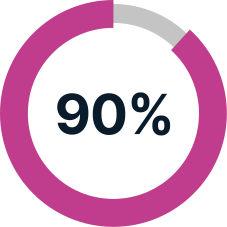
Believe compliance will be “Extremely” or “Somewhat” important over the next 3 years.
Services Offered

I don’t believe every MSP has the skill set to deliver strategic advisory. Each MSP needs to decide what level of support makes the most sense. Do you need to hire for this role and build it internally? Or do you outsource it and hire a consultant? Have you established an advisory relationship with the client? Are you someone that they trust? That will determine the level of technical decisions clients will make with you.
Matthew Bookspan
Founder & President
Blacktip
Cybersecurity, Infrastructure, and Compliance Are Expected To Drive Service Growth in 2026
The services MSPs plan to grow in 2026 mirror the three areas where they already see demand and strategic value; 41% of MSPs plan to grow cybersecurity management, which aligns with talent priorities, as Security Specialists are among the top roles MSPs plan to hire; 32% of MSPs plan to grow infrastructure management; and a quarter of MSPs will grow compliance and GRC services.
Executives and client-facing employees differ in their ideas for growth in 2026. The C-suite is more likely to say they’ll grow cybersecurity and vCIO services, while client-facing roles are more likely to report growth in core services, suggesting a strategic push from leadership to uplevel into strategic advisory and security, while frontline teams see continued pressure on core services.
Top performers tend to offer a wider range of services, including some that are less commonly offered, like:
- Disaster recovery and backup management
- vCIO services
- Productivity and collaboration tool management
- Compliance and GRC services
Services MSPs Plan to Grow in 2026
Compliance Represents a Significant Revenue Opportunity, But Comes With Operational Complexity
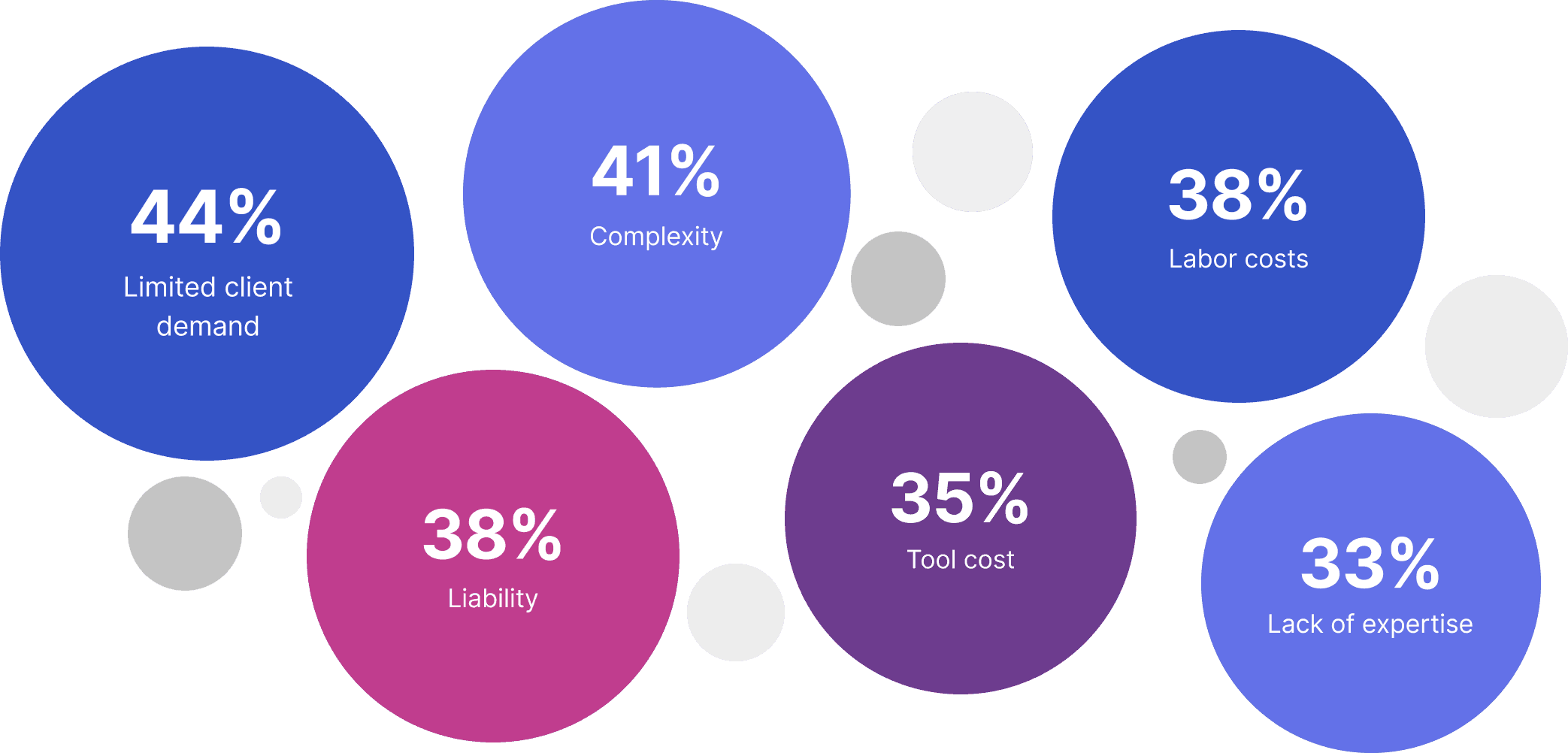
As we highlighted earlier, MSPs that view compliance as “Extremely important” are more likely to project higher growth, report higher CSAT, and have higher confidence in delivering measurable business value. But while MSPs may see opportunity in compliance, many are held back from offering it due to entry barriers, including limited client demand, complexity, and labor costs.
What should you offer if you’re able to expand into compliance? The top services include data protection (offered by 59% of MSPs who offer compliance services), risk assessments (offered by 54%), and employee security awareness training (offered by 51%).

Compliance Services Offered
Barriers to Compliance Offerings
What Top Performers Do Differently
Escape The Commodity Trap With Customer Success
Top financial performers tend to run Customer Success like a well-oiled machine, bringing structure to everything from onboarding to account management to IT budgeting to regular business reviews and strategic vCIO support. They also take the long view and are more likely to build out long-term roadmaps and budget forecasts (one to two years in advance).
They’re also better at showcasing the value they create by tracking more internal customer service metrics (like resolution times, tickets, CSAT, NPS, etc.) and sharing more data points with clients — which explains why they are less likely to report that client objections to pricing prevent them from improving customer satisfaction.