

Many MSPs have the idea that a quarterly meeting cadence is the baseline, monthly is the gold standard, and that anything less is lazy. But meeting frequently doesn’t guarantee results—it just guarantees filled calendars.
The data paints a more nuanced picture of the ideal meeting frequency. While high-performing MSPs tend to meet with clients more often, simply investing more time and effort into quarterly business reviews (QBRs) doesn’t necessarily lead to better outcomes. A more useful question than how often to meet is what those meetings are actually designed to accomplish.
Rather than prescribing a one-size-fits-all meeting cadence, we'll share a mental model for determining what each client relationship actually needs, plus a practical tiering framework for calibrating depth across your client base.
How Often Do the Highest-Performing MSPs Run QBRs?
In our 2026 study, we asked over a thousand MSPs how frequently they ran QBRs—also known as TBRs, MBRs, even XBRs—and correlated this with a number of factors including CSAT scores and QBR effectiveness. MSPs had the following options to pick from: annually, biannually, quarterly, monthly, and “by client request.”
The highest-performing MSPs—i.e. those who rated their QBRs very effective and had the highest CSAT scores—were most likely to run their reviews monthly. This underscores how valuable regular and frequent contact can be for high-performing MSPs serving their best customers. These QBRs can serve to strengthen the relationship, identify any potential issues early on, and carve out time to proactively plan ahead.
The Frequency Trap: Why More Meetings Don't Necessarily Build Better Relationships
While it may be tempting to assume that more frequent meetings automatically lead to better client outcomes, additional effort doesn't always translate into greater client impact. Frequency creates more opportunities to deliver value, but it doesn't create value on its own. The highest-performing MSPs aren't simply meeting more often. They're also better at connecting technology decisions to business outcomes and demonstrating strategic value.
The same study indicates that MSPs with high rates of churn actually spend more time preparing for QBRs than their counterparts with lower churn. This suggests that delivering more value to the client depends on exerting the right kind of effort. Spending hours grabbing data from 12 different tools and presenting it monthly might simply be busy work. Strategic work, on the other hand, hinges on connecting the work you did to your client’s specific business goals.
QBRs as a Double-Edged Sword
More effort can’t compensate for a QBR that fails to demonstrate strategic value. In fact, greater visibility can sometimes expose the opposite. QBRs shine a spotlight on the work you’ve been delivering—and can either amplify your strengths or draw attention to potential weaknesses. Our report found that high-churn MSPs tend to have more executive attendance at their QBRs, indicating that leadership presence doesn’t guarantee positive outcomes.
“Executive presence amplifies whatever positioning you've established," said Luis Giraldo, Chief Evangelist at ScalePad in our recent webinar on high-value QBRs. “If clients see you as a vendor, more meetings accelerate churn. If they see you as a Strategic Partner, they accelerate trust. Presence is a multiplier, not a differentiator.”
Though it’s worth considering that some of this pattern may reflect “good churn”—that is, the proactive off-boarding of poor-fit clients. In those cases, higher churn isn't necessarily a sign of a weak client relationship, but a deliberate decision to focus resources on better-fit accounts.
Reframing the Question: Depth as the Real Variable
The takeaway from these findings isn’t that frequency doesn’t matter. It’s that frequency only creates the opportunity to deliver value—and it’s what you do with that opportunity that matters more. So instead of starting by asking, “How often should we meet?”, start with a more useful question: “What does this meeting need to accomplish?”
That distinction is important because not every client interaction needs the same level of depth. A routine status update might be perfectly appropriate for one account, while another may need a deep strategic conversation that moves an initiative forward.
Deciding what you want to accomplish in a QBR depends on a few factors. You can calibrate the level of depth each client needs by assessing two main variables—maturity and appetite.
1. Maturity
- How mature is the client?
- How deep is your relationship with them?
- Are you just ‘keeping the lights on’ or do you have shared strategic goals?
- How healthy is this account?
- What’s its potential for future growth?
2. Appetite
- What is their appetite for strategic engagement?
- How engaged is the client?
- Are they showing up prepared and involving their key decision-makers?
From there, you can plot your clients against this quadrant framework. Once you’ve determined the client’s segment, it becomes a lot easier to gauge how often and how deep is appropriate for QBRs.
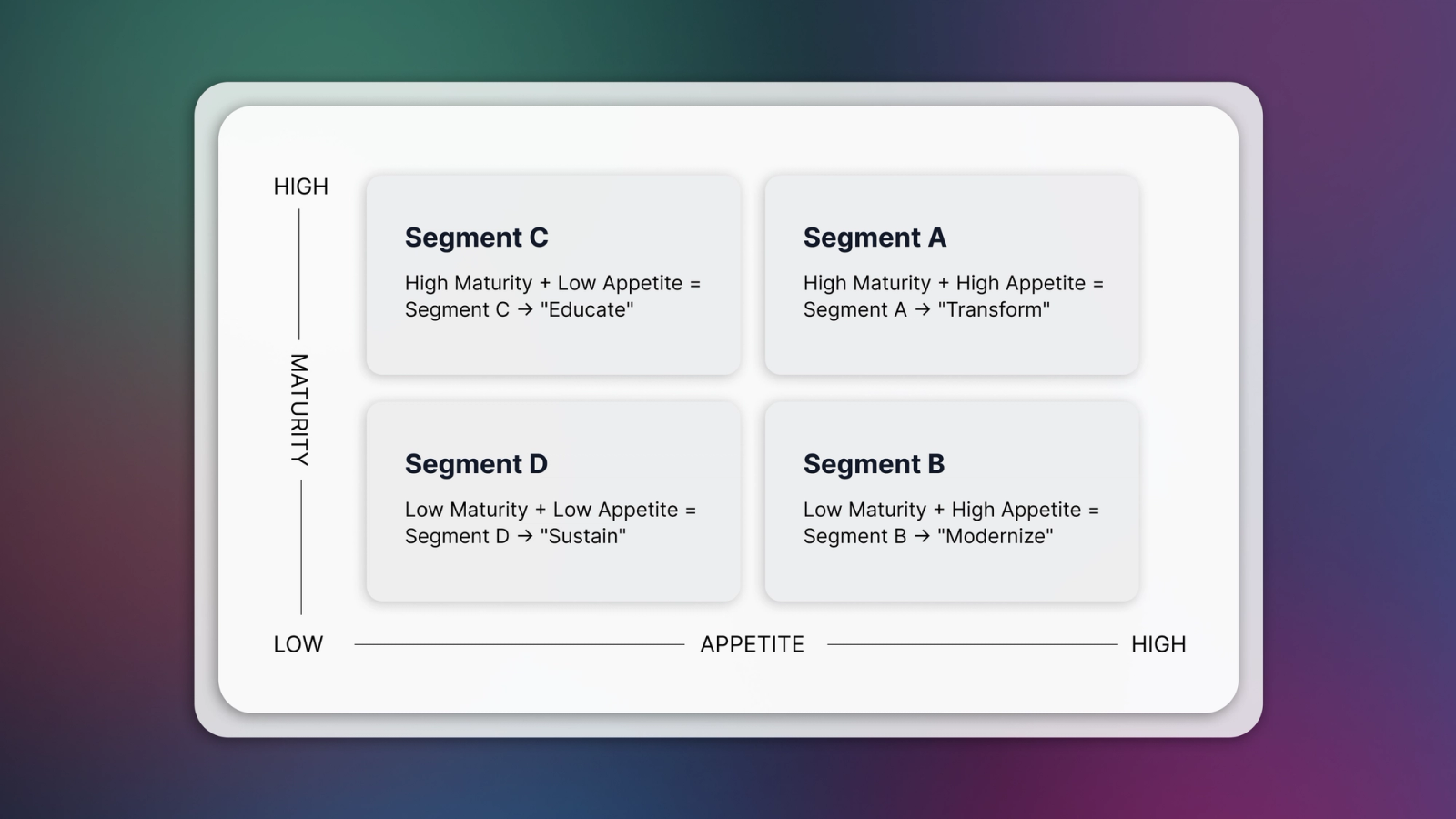
The quadrant framework helps you adapt your approach to different client needs. A ‘Segment A’ client may be unsatisfied with a light-touch approach, while a ‘Segment D’ client may find that to be the perfect level of engagement.
How QBR Needs Differ Across Client Segments
Imagine a long-time client that's actively expanding into new markets. They're engaged, involve executive stakeholders, and regularly ask for strategic advice. That account likely benefits from deeper, more frequent reviews because there are meaningful business decisions to discuss.
Contrast that with a stable client whose environment rarely changes and who primarily values reliable service delivery. Quarterly conversations may provide all the strategic value they need. Increasing the meeting frequency wouldn't necessarily improve the relationship—it would simply create more meetings.
The objective isn't necessarily to give every client the same frequency or experience. The real objective is to invest more deeply in client relationships that can create the most mutual value.
Matching the Right Meeting Type to the Right Segment
Some MSPs may prefer to think of these quadrants as tiers of services. You can invest more time (i.e. longer and/or more frequent meetings) for higher tier accounts.
For example, a Tier 1 account might have a monthly hour-long meeting, whereas a Tier 3 might be satisfied with a 30 minute meeting on a quarterly basis.
Tier 1: Full Strategic Review
Ideal for Segment A & B clients
For clients with active growth goals, strategic alignment, or expansion potential. These meetings should look beyond service performance to upcoming business priorities, technology investments, and strategic decisions. They may warrant longer, more frequent reviews with executive stakeholders. Treat these as a genuine strategic partnership conversation, not a reporting session.
Example cadence: A monthly or bi-monthly 90-minute call, covering OKR progress, innovation opportunities, technology investments, and executive-level strategic priorities.
Tier 2: Progress Check-In
Ideal for Segment C clients
For stable, satisfied clients with no urgent decisions on the table. Focus on progress against existing priorities, emerging risks, and any changes that could require a shift in strategy. A roughly quarterly cadence may provide enough contact to stay relevant without creating meeting fatigue.
Example cadence: A quarterly 1-hour call, covering service performance highlights, low-risk improvement opportunities, and one or two suggested next steps.
Tier 3: Pulse-Check Touchpoint
Ideal for Segment D clients
For low-complexity accounts that benefit from short, consistent touchpoints. Keep these conversations short, consistent, and focused on the basics: confirm that operations are stable, surface any urgent issues, and avoid introducing strategic complexity before the relationship is ready for it.Use these meetings to identify when something has shifted (a new stakeholder, a business change, a rising pain point) that might signal a client is ready to move into a different segment.
Example cadence: A quarterly 30-minute call, covering operational stability, any open issues, and a quick check for changes in business context or appetite.
What Deeper QBRs Look Like in Practice
According to our report, top performers are also more likely to share more operational metrics with customers, contrary to the common belief that clients only want high-level summaries.
That doesn't necessarily mean overwhelming clients with dashboards or technical detail. Rather, it means helping them understand which metrics matter and what they mean for their business. The goal is to move beyond reporting activity and toward interpreting results. For example, reporting on the number of tickets resolved simply shows activity. But showing how a new hardware or software initiative decreased downtime—and how many productive hours that gave back to the business—connects your work to a meaningful business result.
Depth isn't just about longer meetings or more data on the slides. It's about delivering a higher level of strategic guidance and spending less time on table stakes IT reviews. This involves coming in with a point of view as a strategic partner, not just a report. It means tailoring the conversation to where their business is headed, not just how your service is performing. Most importantly, it means making the meeting move something: a decision, a next step, a shared priority.
Match Your QBR Investment to Client Potential
Ultimately, the goal for growth-oriented MSPs should not be more meetings or fewer meetings. It should be matching your meeting cadence—and the resources behind it—to each client’s needs and growth potential.
The best MSPs don't start by asking how often they should meet. They start by asking what each meeting needs to accomplish. Once that's clear, frequency becomes a natural byproduct of that decision.