

Backup monitoring is evolving. These days, clients don’t just expect backups to run. They expect clarity, accountability, and recovery that you can prove. Defining Service Level Agreements (SLAs) and Recovery Point Objectives (RPOs) is how MSPs move from "we backed it up" to "we’ve got you covered."
In this article, you’ll learn
- What SLAs and RPOs actually mean in backup terms
- Why these metrics matter for client trust and business continuity
- How aligning backups to each client’s needs and expectations changes the game
- Simple ways to bring these standards into your daily workflow
Backup monitoring has long been a technical function: track job statuses, resolve failures, and keep things running. But the landscape has shifted. Now, backups aren’t just infrastructure. They’re business assurance. And increasingly, MSPs are asking themselves outcome-related questions about their backups:
- What’s our defined threshold for backup success?
- And each client’s tolerance for loss?
- What’s our escalation timeframe?
- When will we know about failed backups?
- Why do I keep getting ticket alerts that aren’t urgent?
These aren’t theoretical questions. They’re specific compliance requirements, board-level concerns, and high-stakes business continuity decisions.
And that’s where SLAs and RPOs come in. These aren’t buzzwords, they’re operational standards.
Let’s unpack what these concepts mean and why they are core pieces of a modern backup offering.
SLAs: Clarity around commitments
A Service Level Agreement (SLA) is more than a contractual checkbox. It’s how you define what “success” looks like in your backup service.
When an MSP configures backup monitoring based on SLAs, you’re not just saying “we’ll alert if the job fails.” You’re saying:
- We’ll detect when backup success drops below a defined threshold.
- We’ll escalate within a set timeframe.
- We’ll measure performance against agreed standards — and report on it.
That clarity does two things:
1. Sets mutual expectations: Your team knows the targets. Your client knows what’s being delivered.
2. Creates accountability: It’s not about perfection. It’s about visibility. When SLAs are tracked and monitored, issues don’t turn into surprises.
In short, SLAs make sure you and your client are always on the same page, which lets you shift from reactive firefighting to predictable, consistent delivery.
Focus on what’s actionable (and ignore the noise)
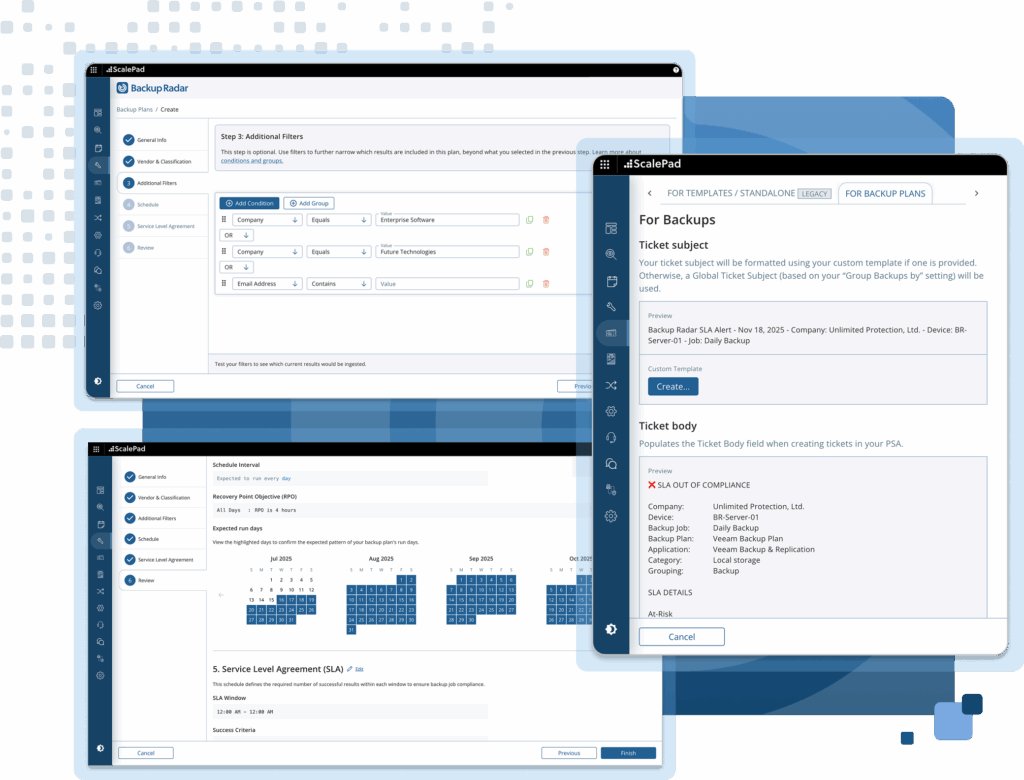
Aligning backup monitoring to SLAs and RPOs makes it easy to prioritize action items for your team. Now, you don’t have to chase every alert — only the ones that truly matter.
Let’s say a client device requires one successful backup per day. The first two jobs fail, but the third succeeds. So, you're still within your SLA. You’ve met the RPO. The client’s data is safe. And most importantly, you don’t need a ticket created.
This functionality lets you define action items based on business risk, not just technical outcomes like a “successful” or “failed” job (because a failed job doesn’t always mean a failed service).
So, instead of opening tickets for every hiccup, you only focus on what actually impacts the client’s data protection.
The result is fewer distractions, faster triage, and better prioritization. This is how you align your processes to match your client’s risk tolerance.
RPO: Quantifying the value of data over time
The Recovery Point Objective (RPO) defines how much data a client is prepared to lose in a worst-case scenario.
- A 24-hour RPO? Daily backups suffice.
- A 30-minute RPO? You need continuous replication or high-frequency jobs.
But here’s the nuance: RPO isn’t just a backup schedule; it’s a risk decision. And the right RPO varies by business unit, workload, and even time of day.
When MSPs align backup monitoring to RPOs, they move beyond simple “pass/fail” job checks and ensure only actionable events trigger tickets.
This process evaluates
- Is this system being protected as frequently as the client’s organization needs?
- Are backup windows and frequencies still aligned to the current business needs?
- If something fails, how far back will we have to go to restore the data?
Tracking RPOs in backup monitoring allows you to surface gaps before they become losses. It also invites a more strategic conversation with clients — how much data can you afford to lose, and where can you afford to lose it?
These conversations establish your MSP as more than a tech provider, but a true partner.
Transition from job monitoring to outcome monitoring
Historically, most backup monitoring has been job-based. Did the job run? Did it complete? Did it fail?
But this approach has limits.
A job might be successful in the morning and afternoon, but not meet the client’s 1-hour RPO.
Or a job might fail five times before succeeding once. But with an SLA of one successful backup per day, these failures aren’t actionable (or even a priority).
SLAs and RPOs allow MSPs to move beyond binary success-or-failure monitoring and start measuring outcomes
- Are we meeting the defined RPO based on the client’s risk tolerance?
- Are we prepared to deliver on our promise if something fails?
- Does that match the terms of the SLA?
This approach lets you align technical performance to business expectations.
Why an SLA-centric approach elevates your backup offering
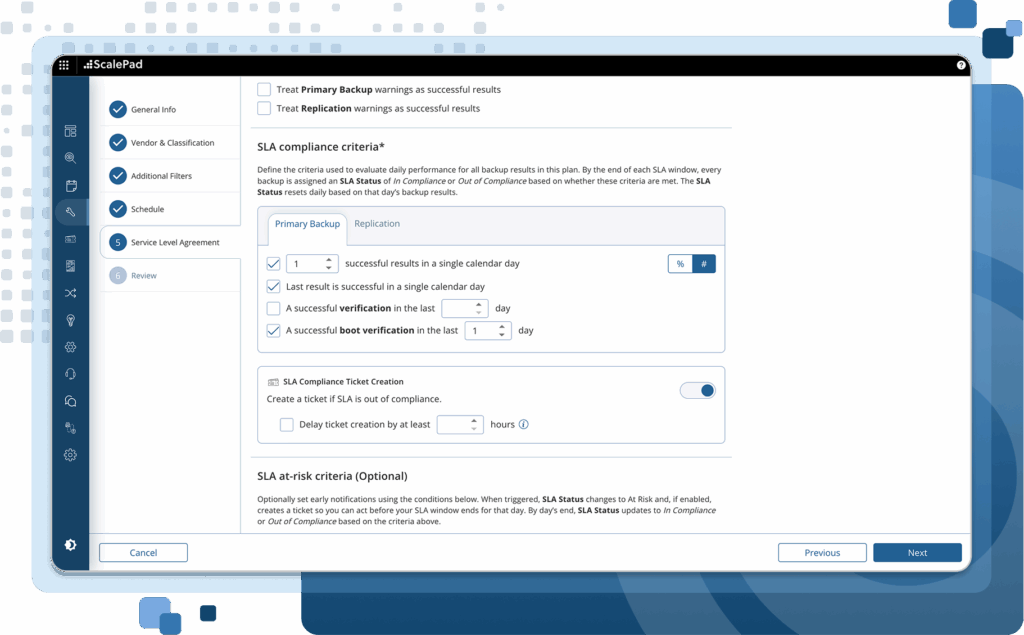
Integrating SLAs and RPOs into your backup workflows has clear operational benefits. But it also unlocks bigger opportunities:
- Easier compliance reporting:
Many industries now require proof of recovery standards for compliance. These metrics give you the evidence. - Build trust with clients:
You’re not just reviewing ticket volume and response times. You’re reporting on backup performance against real business metrics. That makes you an integral partner to their success. - Faster client decision-making:
When clients truly understand the risks and trade-offs, they are more likely to say “yes” to infrastructure improvements. - Positioning shift:
You’re not just the MSP managing the backup tool. You’re the advisor guiding data resilience and recovery planning.
And when backups become measurable, they become more meaningful.
Change the conversation — backups are business assurance
Backups are no longer just a technical checkbox. They’re a business-critical process that needs to be measurable, explainable, and defensible.
SLAs and RPOs provide the structure to do exactly that. They help you standardize your delivery, align with expectations, and turn recovery performance into a strategic advantage.
Clients want transparency and predictability. They want to know their data is in good hands. And they want to know that if an event occurs, recovery will be fast, complete, and aligned to their needs.
With these metrics in place, you offer more than just backup monitoring. You offer business assurance. That’s how you go beyond being a service provider and establish yourself as a trusted partner — an essential part of your client’s business.