

CMMC 2.0 enforcement is here — Phase 2 is being rolled out by the Department of War (formerly Department of Defense), marking the most significant expansion of defense cybersecurity standards in over a decade. For MSPs, this presents a series of challenges, but also a massive opportunity to support clients through this transition.
CMMC 2.0 enforcement has arrived, impacting over 300,000 organizations globally today. This number is projected to reach 500,000 businesses by 2030 as requirements expand across allied defense and government agencies.
But if you’re reading this, you’re still early — 2025 is not late for CMMC adoption. While there is an enormous amount of work on the horizon, it will have a massive real-world impact. Whether you’re a vendor, MSP, or government contractor, we’re all in this together to secure our national best interests.
The Department of Homeland Security (and multiple other agencies) have signalled interest in strengthening Controlled Unclassified Information (CUI) protections and aligning with NIST SP 800-171 security requirements. They’re watching this rollout closely.
Every organization in the Defense Industrial Base (DIB), and the MSPs supporting them, must now demonstrate ongoing cybersecurity maturity, not just one-time compliance. But CMMC 2.0 isn’t a one-and-done project. It’s a continuous, evolving framework that demands visibility, adaptability, and assessment readiness at all times.
For MSPs, this presents several key challenges (more on those below), but also a massive opportunity to strengthen relationships with clients impacted by CMMC changes and position your business as an invaluable compliance partner.
CMMC 2.0 — What changed?
As of November 2025, here are the key changes that come with CMMC 2.0:
- Mandatory third-party assessments for all CMMC Level 2 contractors (aligned to NIST SP 800-171).
- The expanded scope applies to contractors, subcontractors, partner nations, and global defense suppliers connected to U.S. systems.
- Contractors handling CUI must meet Level 2, (including all 110 NIST 800-171 controls) validated through formal, evidence-based assessments.
- Contractors handling FCI data must meet Level 1 and 15 controls.
- CMMC requires ongoing maintenance, annual self-assessments, and periodic third-party assessments, making compliance a continuous effort rather than a one-time event.
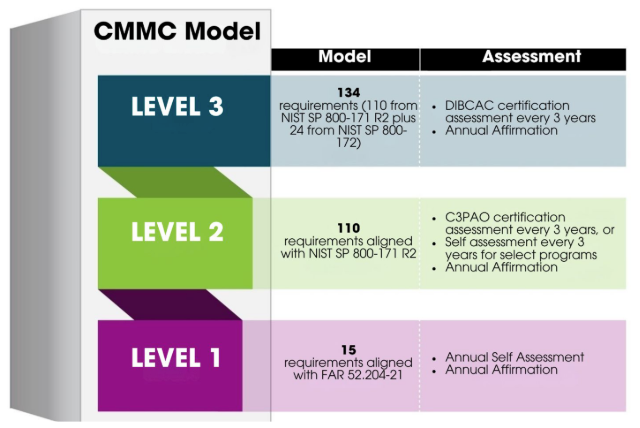
What this means for your clients:
Non-compliance may disqualify contractors from bidding or renewing eligible contracts as requirements phase in. Contracts can even be suspended or lost without proof of certification. Clients who fail to prepare for this ahead of time risk contract disruption, revenue loss, and federal ineligibility.
For MSPs, that means potential client churn and revenue instability if clients lose their government contracts.
So, how can MSPs get clients CMMC 2.0 compliant? First, let's break down the challenges in more detail:
Challenge #1: Clients are stressed, overwhelmed, and panicking
CMMC 2.0 requirements are a seismic shift across the industry, hitting small businesses and entire communities and regions that rely on federal projects. Some small business owners are even choosing to retire or sell their business rather than tackle this change and retain their government contracts.
It is still very early, and just about every contractor is preparing for CMMC 2.0 requirements. These businesses require your assistance in implementing technical controls, reviewing documentation demands, and managing the substantial workload necessary to demonstrate compliance. Many lack internal security teams or don’t know where to start with frameworks like NIST 800-171, 800-171A, or CMMC Level 2 readiness.
Basically, your clients need help to avoid losing contracts — MSPs have become their first line of defense and reassurance. You can lead with confidence and a clear path forward, helping clients go from confusion to compliance.
Challenge #2: CMMC 2.0 is hard, and scaling it is harder
Let’s be honest: achieving CMMC 2.0 is hard — anyone who says differently either doesn’t understand it or is trying to sell you something. Each update adds new expectations around evidence collection, assessor validation, and documentation traceability.
Manual tracking and shared spreadsheets quickly break down. This causes errors, inconsistent delivery, and missed deadlines. To stay ahead, scalability is everything. MSPs can standardize and replicate these requirements across multiple clients, each with unique environments and varying readiness, to effectively manage CMMC at scale.
Scaling CMMC 2.0 compliance requires automation, templated processes, and centralized visibility, or MSPs risk falling behind with every new update. See how MSPs are preparing for CMMC enforcement.
Challenge #3: Assessors (C3PAO) are limited
The pool of certified C3PAOs (third-party assessment organizations) remains small, with only 90 C3PAOs in the market (as of December 1st, 2025). But demand is exploding. As enforcement accelerates through 2026, assessment scheduling backlogs are already forming.
Contractors are competing for limited assessor availability, and delays in System Security Plans (SSPs), Plan of Action and Milestones (POAMs), or evidence mapping can result in missed contract windows.
MSPs can support clients in being assessment-ready early — ensuring every document, artifact, and evidence package is verified and exportable well in advance of review.
The opportunity for MSPs
Compliance is now one of the fastest-growing MSP offerings. CMMC 2.0 creates both urgency and opportunity for MSPs.
MSPs that act now can
- Build recurring compliance revenue streams by managing continuous CMMC readiness.
- Deepen trust and stickiness with clients through proactive cybersecurity leadership.
- Position themselves as strategic compliance partners, not just IT vendors.
As CMMC 2.0 expands across agencies and allied nations, MSPs that master compliance delivery today will be positioned to serve an entire new wave of defense-aligned clients.
Turning CMMC chaos into clarity
ControlMap is an all-in-one compliance platform for MSPs, enabling MSPs to run assessments, collect evidence, map controls, and manage multiple frameworks across clients in one system — accelerating time-to-value for multi-client compliance programs.
The platform is purpose-built for MSPs managing CMMC 2.0 and NIST 800-171 compliance across dozens of client environments.
With ControlMap, MSPs can:
- Run readiness and gap assessments using NIST 800-171A and generate a SPRS score report automatically
- Automatically generate System Security Plans (SSPs) and Plans of Action and Milestones (POAMs).
- Define ownership with the Shared Responsibility Matrix (SRM) — clarifying MSP vs. client obligations.
- Maintain version-controlled evidence mapped directly to evolving CMMC 2.0 requirements.
- Export complete, assessment-ready packages of reports and evidence in formats assessors expect ready for eMASS / DIBCAC upload.
Conclusion
CMMC certification can be hard, especially Level 2 with 110 controls. And it doesn’t happen overnight. While this is a massive opportunity, it’s also a significant responsibility for MSPs.
ControlMap has 500+ active clients working towards achieving CMMC certification readiness(which is massive, considering how few businesses have achieved this certification), and we’re preparing thousands more in the months to come.